



















In modern logistics and transport industry, self-loading ability has become an important indicator of transportation efficiency. Loader crane (manipulator crane), as a key equipment for realizing the self-loading function on trucks, has shown a steady increase in market demand. Among them, the kink-boom crane (kink-boom crane), due to its unique design and flexible operating characteristics, stands out with significant advantages in confined spaces and in precise handling of loads, making it especially popular in urban logistics and municipal facilities. Unlike stationary loading cranes, a loader crane provides mobility and autonomy, allowing loading and unloading operations to be performed at any point along the route without the involvement of additional equipment. This feature is especially valued in the segment of small wholesale and retail transportation, which requires prompt unloading of goods directly at the destination without organizing a special loading area. In an increasingly competitive transport market, having your own a loader crane becomes a competitive advantage that allows you to offer customers an expanded range of services and reduce delivery time.
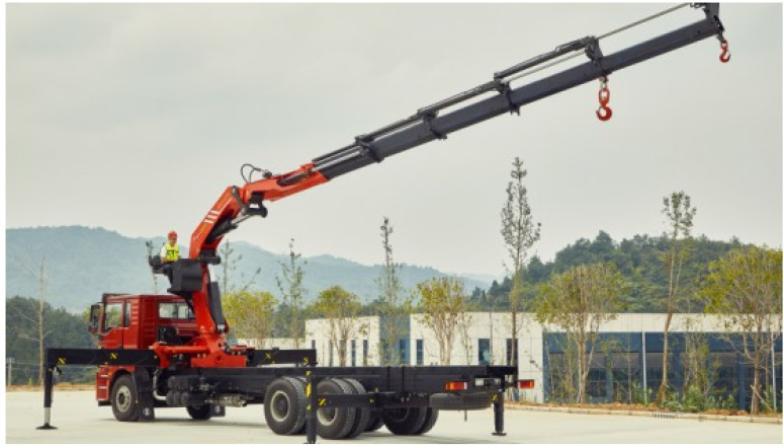
The key feature of the crane boom crane is that its boom consists of a main and an additional section, connected by an articulation, forming a folding geometric structure. This design allows the boom, when folded, to be compactly placed behind the driver’s cab, significantly reducing the space occupied during transportation and not exceeding the permissible overall dimensions for road traffic. If work is necessary, the boom is deployed by hydraulic cylinders, and telescopic sections provide a wide working coverage. Compared to a jib structure, a jib crane with equal installation space usually provides greater operating flexibility and a more favorable load curve, allowing operations in hard-to-reach areas. The ability to fold the boom into several links ensures minimal transport dimensions, which is critical for working in urban environments with limited roadway widths. Thanks IzlThanks to its unique design, the operator can lift cargo from holes and trenches, as well as place cargo behind obstacles, which is impossible when using boom analogues. The number of telescopic sections and the degree of their extension determine the maximum radius of action and lifting height of a particular model.
In conditions of limited space, the advantages of a crane with a broken jib are especially obvious. Urban transport, intra-warehouse loading and work on narrow streets require lifting equipment to carry out complex lifting paths in cramped conditions. The broken design allows the operator, by controlling the hinge angle and the length of the telescopic sections, to precisely position the load hook, avoid obstacles and penetrate into the body - operations that are difficult or impossible to perform with a jib crane. This spatial adaptability makes cranes the preferred choice in urban logistics, municipal services and warehouse operations where every meter of workspace matters. Such equipment is especially effective when unloading in narrow courtyard passages, where there is no possibilityThe importance of installing stationary lifting mechanisms. Kinky boom cranes are also used in municipal services for servicing manholes, installing road signs and loading containers with household waste. The ability to work with a negative reach allows loading outside the vehicle's support area, which expands the service area without additional relocation.
From a technological point of view, modern jib cranes are widely equipped with advanced proportional valve control systems. The system converts operator handle movements into precise distribution of hydraulic flow, providing smooth integration of lift, reach, telescoping and swing. For logistics operations that require frequent multi-point positioning, this precise control can effectively reduce load swing, improving handling efficiency and operating safety. Some premium configurations integrate radio control, allowing the operator to remotely control equipment from a position with optimal visibility, further enhancing flexibilityand operational safety, especially when handling fragile or dangerous loads. Radio control also allows the operator to remain in a safe zone when handling unstable or heavy loads, minimizing the risk of injury. The use of an oil recycle system when telescoping increases the extension speed and speeds up the work cycle, which has a positive effect on overall productivity. The ergonomic arrangement of control levers on the operator's console reduces fatigue and increases the accuracy of operations during long-term work.
In terms of structural strength, the main boom of the flex boom crane is usually made of high-strength alloy steel and undergoes strict welding and heat treatment process. The boom cross-section, often shaped like a hexagon or octagon, provides optimal resistance to bending and torsion while reducing the weight of the structure. For logistics enterprises operating under long-term high load conditions, the structural reliability and overhaul interval of equipment directly affect operating costs. Therefore, when purchasing, you should pay attention toSevere attention to the manufacturer's material standards, process level and warranty policy, as this determines the total cost of ownership throughout the entire life cycle. The use of high-strength steels makes it possible to withstand increased loads while maintaining a relatively low weight of the structure, which has a beneficial effect on the load-carrying capacity of the base chassis. Adjustable guide shoes provide optimal lateral guidance of the telescopic system, extending the life of the extension mechanisms. Retaining valves, fitted as standard on all hydraulic cylinders, prevent the boom from lowering spontaneously when hydraulic power is disconnected.
From the point of view of application adaptability, crane boom cranes are widely used in the delivery of construction materials, transportation of industrial equipment, maintenance of municipal facilities and loading of agricultural products. Different industries have different requirements for load torque, reach and additional features. Transportation of construction materials requires a larger load moment and longer distances.awns of action; whereas when handling precision equipment, control accuracy and stability are critical. Before purchasing, users should carefully evaluate the frequency of work, the nature of typical loads and the technical parameters of the installation chassis, selecting the appropriate model that optimally combines performance and efficiency. The presence of additional hydraulic outlets for connecting attachments, such as hydraulic grabs or forks, significantly expands the functionality of the crane and allows it to be used as a universal loading crane. Another important factor is the ability to install different types of operator seats - from floor controls to an overhead seat with a panoramic view, which allows you to adapt the workplace to specific operating conditions.
When purchasing loader cranes in Russia and neighboring regions, in addition to the technical characteristics of the equipment, you should evaluate the manufacturer’s ability to provide localized service. The availability of spare parts in stock, the speed of response of technical support and the degree of development of the personnel training system are all okhas a significant impact on long-term economic efficiency of operation. Manufacturers with a global presence and localized service network are able to provide users with a full cycle of support - from selection consultations to after-sales service, which minimizes downtime and ensures smooth production processes. Regular training of operators and technical personnel helps improve skills and reduce the number of operational errors, which directly affects the service life of the equipment. The availability of engineering design software allows you to calculate the stability of the installation in advance and select the optimal configuration for a specific chassis, which reduces preparation time and increases installation accuracy.
Overall, the crane boom crane, with its compact structure, flexible operation and outstanding spatial adaptability, has become an indispensable efficient equipment in modern logistics. When making purchasing decisions, users must comprehensively evaluate the technical characteristics, suitability for application scenarios and service capabilities of the manufacturer formaximizing return on investment and ensuring long-term operational reliability. The correct choice of a loading crane allows not only to increase the efficiency of logistics operations, but also to significantly reduce dependence on third-party loading services, providing complete control over cargo handling processes. In an increasingly competitive transport market, having your own loader crane becomes a competitive advantage, allowing you to offer customers an expanded range of services and reduce delivery time. If operating recommendations are followed and timely maintenance is carried out, the service life of a modern crane can reach several decades, providing a stable return on investment.
To view detailed technical parameters and configuration options for jib cranes, visit: