




Doroshenko V. S. casting steel and cast iron for ice models

Foundry of metal blanks is the main procurement base of the machine -building complex as the basic industry. The volumes of production of cast preparations are proportional to the volume of engineering production, since the proportion of cast parts in cars, tractors, combines, tanks, aircraft and other machines is 40-50%, and in metal-cutting machines and blacksmithing equipment it reaches 80% of the mass of the product. Today, in the current foundry of Russia and Ukraine, in the production of 1 tons of cast iron, about 50 kg of dust, 250 kg of carbon monoxide, 1.5-2.0 kg of sulfur oxide, 1 kg of hydrocarbons and forms up to 5 tons of solid sand waste are released. The processes using synthetic resins and other organic binders, which give up to 70% of the natural environment from foundry workshops are especially environmentally sound, are especially unsafe [1].
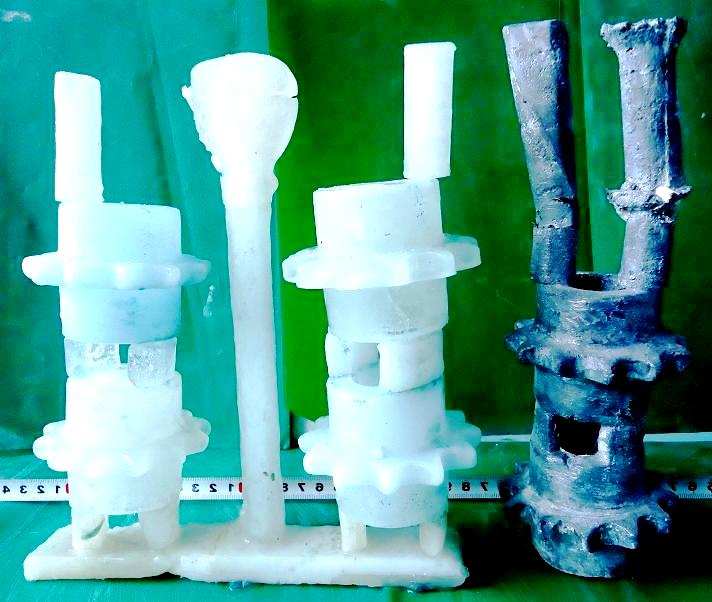
The use of cryotics for obtaining metal excursions in sand forms allows you to create low -waste and non -waste processes, the displacement of organic materials from the manufacturing technology of casting forms prevents environmental pollution. High norms of resource conservation are reached by re -use of molding materials. Since every year in the world steadily increases the production of castings by casting according to one -time models, which gives accurate casting, contributes to a decrease in the metal consumption of castings and brings them closer to the final part, then casting according to models from frozen water refers precisely to such special models of casting.
Attraction of cryotics for obtaining sand forms according to one-time ice models in most varieties of methods excludes organic modeling materials from the process and minimizes the use of thin-walled shell forms. The use of aggregate water transitions (from liquid to solid - when freezing the model, again into the liquid - when the model is melted and the liquid is absorbed into the sand to free the cavity of the form, and then evaporation - when drying a moistened shape) to some extent similar to the circulation of water in nature. The idea of the cyclicity of material resources as a method of environmentalization of production is borrowed from nature, where, as you know, closed cyclic processes apply, inheriting which can be brought closer to biosphere laws, and primarily the law of the cycle of substances. Water for ice models by 30-90% and dry sand of the mold by 80-90% (minus the sand of the shell participating in the formation by impregnation-moisturizing), can be used many times.
A variety of vacuum molding on ice models (packed in foam) was developed, in which water does not fall into the sand of the mold, and can be fully used along with repeated use of sand. This technology refers to cryo-vacuum processes in which dry sand (without binding) is strengthened under the influence of vacuum when connecting foundry forms to the vacuum pump [2]. At the same time, casting according to ice models is combined with vacuum-lane molding (VPF), which is the most environmentally friendly method of sand forming and abroad in recent years has passed from the category of special casting in the main ways to produce castings into one-time sandy forms [1]. In the GAZ VPF arising when pouring molten metal into a foundry form, they almost completely pump out a vacuum suction from the mold, and the absence of a binder in dry quartz sand reduces such gas expulsion to a minimum.
Environmental advantages of casting according to ice models are obvious when replacing them with traditionally used smelted paraffin-stairing models (LVM method) or gasified (burned) melt of metal models from polystyrene foam when filling the foundry form (LGM method). In LVM, the consumption of the model composition per ton of suitable castings is 40 ... 90 kg at 10% of losses, most of which occurs when coed in thermal furnaces of shell forms at high temperatures and burning out model material not removed from them. This leads to smoke emissions in the foundry, requires the installation of exhaust ventilation and purification of gases released into the atmosphere.
As for the use of polystyrene foam for models, its consumption is about 6 ... 6.5 kg per ton of castings, and it is destroyed with high -temperature destruction. When burning without the formation of a solid balance, a mother is released by 1 m³