



















When a worn steel grating panel on a walkway, platform, stair tread, or trench cover needs replacement, a familiar shorthand often appears on internal requests: match the existing panel depth and specify "FRP," "GRP," or "fiberglass grating." Matching depth feels intuitive because a same-thickness panel should sit flush in the frame. Structurally, however, that shorthand leaves the specification incomplete twice over.
Even within steel bar grating, overall panel depth alone does not define stiffness or load capacity; bearing-bar section, bar spacing, clear span, and support layout govern how the panel performs. Copying only outside depth strips away those details from the steel deck, while pairing that depth with a generic family name leaves the replacement equally undefined because "FRP," "GRP," and "fiberglass grating" do not identify internal construction, resin chemistry, or structural ratings.
That omission cuts against two common assumptions. Matching a steel panel's depth does not establish equal stiffness or load capacity in fiberglass, yet equal thickness does not automatically make fiberglass weaker or stronger than steel either. Steel and fiberglass grating each have their own conditions of use, and neither generally replaces the other. No universal conversion factor, stiffness ratio, or thickness multiplier turns a steel depth into an equivalent fiberglass specification. Outer depth is only a rough height envelope; structural equivalence depends on internal load path, spanning members, clear span and end bearing, load type, and matched deflection and capacity data.
Inside the Panel: Molded vs. Pultruded Load Paths
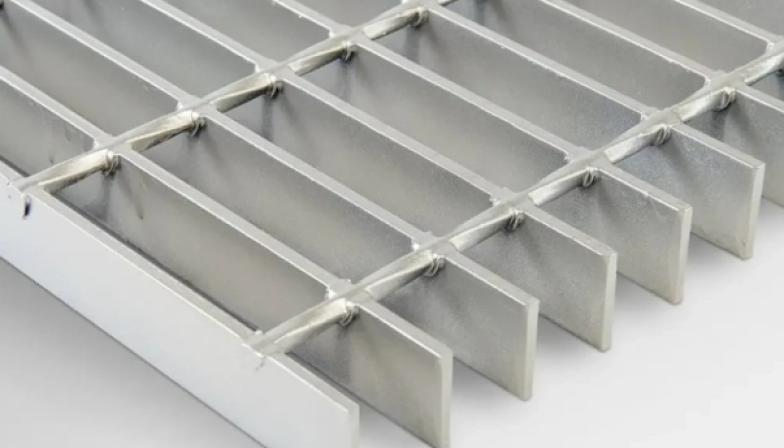
Grating does not behave like a uniform solid slab. In steel bar grating, primary bearing bars span between supports while secondary cross members space and stabilize them. Fiberglass grating handles load transfer through more than one internal architecture: pultruded panels separate principal spanning bars from connecting cross rods, whereas molded panels form an integral intersecting mesh.
The photographs in this section show the construction of the individual specimens. They are not a same-thickness comparison, and they do not by themselves prove load capacity, dimensions, certification, or performance.
Figure 1. Close-up of a steel bar grating panel, with parallel flat bearing bars and twisted cross rods joining them.
A generic family label leaves out how FRP grating is actually built: molded and pultruded constructions do not share the same internal load path or spanning orientation, even when two panels have the same color and nominal thickness.
In pultruded grating, parallel bearing bars carry the principal load along their length and must reach the intended supports. Cross rods connect and space the assembly; they are not an interchangeable second principal spanning direction. Width and bearing-bar length cannot be interchanged merely because a panel fits an opening after rotation, so a panel can drop cleanly into a frame and still be oriented wrongly.
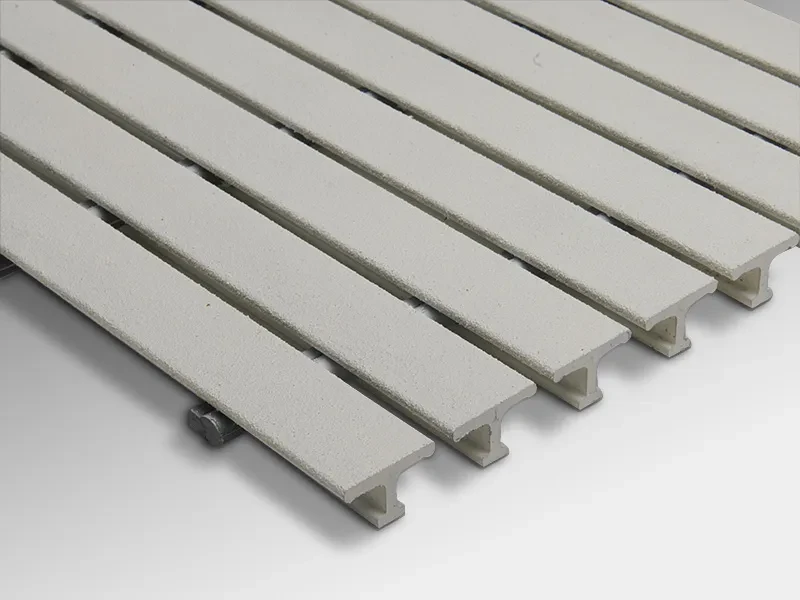
Figure 2. Close-up of one pultruded fiberglass grating panel with wide-flange I-shaped bearing bars and narrow slots between them. Other pultruded open-mesh panels may use different bar profiles and spacings.
Molded grating is an integral intersecting mesh. In an intact square mesh, intersecting bars can share load in both directions, which is why molded grating is generally described as bidirectional. Even so, that description applies to an intact integral mesh and still depends on the specific panel, support layout, and load case. Molded grating is not automatically equivalent in every direction, on every support layout, or after every cutout; cutting an opening interrupts the grid, and two-way construction does not make cutouts self-supporting.
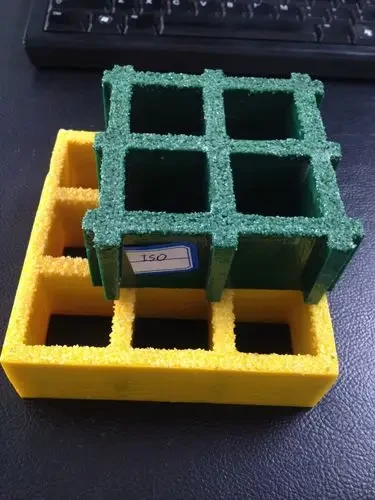
Figure 3. Small cut samples of molded fiberglass grating (not an installed panel), showing an integral square mesh and gritted surfaces.
Illustrative example: Picture an access opening supported along two opposite edges, and two fiberglass panels of the same color, nominal depth, and outer plan size: one an integral molded mesh and one pultruded. Before any load table is consulted, they transfer load differently. If the pultruded panel is placed so that it still fits the opening while its bearing bars run parallel to the two supports instead of bridging between them, only its cross rods span the gap. Thickness and perimeter fit look unchanged, yet the spanning members are no longer doing the spanning work. That orientation error does not imply either construction is stronger or safer; it simply shows why outer depth and perimeter fit do not reveal load path.
Clear Span and End Bearing vs. Outer Fit
Outside panel dimensions and frame openings are also easy to confuse with structural span. Two boundaries govern how a panel works in place: clear span and end bearing.
Clear span is the unsupported distance between effective support edges, not automatically purchased panel length, outside frame size, support center-to-center spacing, or fastener spacing. Purchased length is not allowable unsupported span, and generous overlap on a frame can still conceal a different clear span underneath.
End bearing is the length of each load-carrying bearing-bar end that actually rests on an effective structural support. Contact with loose trim, a clip, or a cross rod does not automatically provide that bearing. Because performance depends on how the panel meets its supports, replacing steel with fiberglass requires checking supports, clear span, and openings. The supporting frame, cutout framing, and fixings may also need changes; a matching thickness and opening size should not be assumed to provide drop-in compatibility.
Illustrative example: Consider a replacement panel cut to match a walkway frame opening, where someone compares its outside length or support center-to-center spacing against a generic span figure. Underneath, however, the effective support edges set a different clear span, some bearing-bar ends sit only over loose trim or clips, or a pipe cutout interrupts bars without framing under the cut edges. At walking height the panel fits flush at the original thickness, yet the actual span and end bearing do not match the assumed geometry. Flush fit at the original thickness therefore does not establish support equivalence, even before capacity or safety is evaluated.
Reading Load and Deflection Data on the Same Basis
Even once construction, orientation, clear span, and end bearing are defined, a detached load or deflection figure does not prove equivalence on its own.
First, load type matters. A uniformly distributed load result, pedestrian rating, or generic load claim does not automatically approve concentrated point loads, equipment feet, wheeled carts, or vehicle traffic, because local contact loads concentrate demand differently from an evenly distributed load.
Second, deflection is a serviceability reading rather than a proxy for strength or depth. It must be read with the applied load, clear span, support condition, and acceptance limit. Low deflection at one load does not prove strength or suitability at a higher or different load, while comparing breaking strength or thickness alone misses service deflection.
Third, recommended, design, and ultimate (breaking) values are different bases and are not interchangeable. A valid comparison holds finished-panel construction and geometry, clear span, end bearing, load type and magnitude, and allowable deflection limit fixed. Before judging any product sheet against those criteria, actual service loads and deck conditions on the structure should be established separately.
Non-Structural Limits of Thickness and Family Labels
Matching thickness and naming a composite family also stop short of proving non-structural performance. Generic labels such as "FRP," "GRP," or "fiberglass grating" do not specify resin chemistry or walking-surface finish, so two panels of the same depth and construction can use different resin or surface systems. Open-mesh grating drains through its openings and is not a waterproof or liquid-containment floor. A "flame-retardant" label or a single fire test is not a structural fire rating, and low electrical conductivity is not an approved electrical insulation system.
The table below summarizes what common replacement shorthand can indicate versus what it cannot prove alone.
|
Shorthand or Information Given |
What It Can Reasonably Indicate |
What It Cannot Prove Alone |
|---|---|---|
|
Matched nominal thickness / overall depth |
Approximate height envelope for clearance and flush fit. |
Equal stiffness or capacity, original steel bar geometry, replacement fiberglass construction, or that equal-depth fiberglass is always weaker or stronger. |
|
Generic family name and color ("FRP / GRP / fiberglass grating") |
Broad composite family and surface appearance. |
Molded vs. pultruded construction, resin system, surface finish, or any structural, fire, or electrical rating. |
|
Construction type alone ("molded" or "pultruded") |
Integral intersecting mesh vs. parallel bearing bars with cross rods. |
For pultruded panels, that bearing bars bridge the intended supports; for molded panels, equal capacity in every direction, on every support layout, or around cutouts. |
|
Purchased length, outside size, frame opening, or centerline / fastener spacing |
Cut perimeter or nominal frame layout for fit planning. |
Actual unsupported clear span between effective support edges, or effective end bearing rather than contact on loose trim, clips, or cross rods; purchased length is not allowable span. |
|
Detached load or deflection figure |
Reported response only under the stated condition for that exact product. |
Concentrated, equipment-foot, or vehicle suitability from a uniform/pedestrian result; strength at another load from one deflection figure; equivalence across recommended, design, and ultimate bases. |
|
Non-structural shorthand ("open mesh," "flame-retardant," "low conductivity") |
Broad non-structural traits rather than qualified performance ratings. |
Waterproof or containment performance, a structural fire rating, or an approved electrical insulation system. |
Specifying an equivalent fiberglass replacement therefore depends not on copying steel depth onto a family name, but on reading construction, spanning orientation, clear span and end bearing, load type, paired deflection and capacity bases, and separate non-structural qualifications together.